“For the first time in history, obesity has surpassed underweight rates among adolescents worldwide,” states a September 2025 report by UNICEF <https://www.unicef.org>.
Children across the globe are experiencing a severe wave of malnutrition, with middle- and low-income countries being the most affected. Ultra-processed foods are rapidly replacing fruits, vegetables, and protein during a critical stage of growth, when children need proper nutrition the most.
According to the report, the global obesity rate among adolescents has increased from 3 percent to 9.4 percent. While undernutrition remains a serious issue, obesity is rising at an alarming pace, creating a double burden of malnutrition.
Convenience or a lie?
Time constraints and convenience play a major role in students’ food choices. “It requires less effort for them to eat something they like than to prepare a healthy meal,” said Pedro Castaneda, a senior at Miami High. Fast food may seem affordable and efficient, but it is not a reliable solution in the long run.
One common myth is that fast food is cheaper than healthy food. In reality, the cost of fast food has risen significantly. According to a company fact sheet, the average price of a McDonald’s menu item increased by approximately 40 percent between 2019 and 2024, challenging the idea that fast food is the most affordable option.
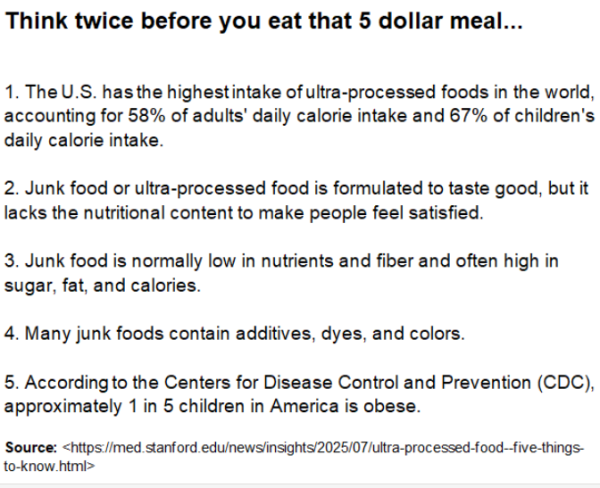
According to the article titled “Junk food is engineered to taste good, not satisfy” published in the website for UCLA Health System <https://www.uclahealth.org>, foods are being altered with a lot of artificial preservatives “Ultra-processed foods are precisely formulated to tease our palates with just the right blend of sweet, salty and fatty flavors. They keep us reaching for more, and at the same time prevent us from feeling completely satisfied.
This flavor is what keeps young customers attached to junk food senior Jaden Castro mentioned, “Junk food is cheaper and tastes better.”
Bad habits come at an early age as Mr. Ladislao Brborich, a teacher of algebra honors and also coach of the wrestling team at Miami High, said: “A lot of parents don’t have the education on nutrition to know what their children are eating. The hard truth is that they are being fed with synthetic food.”
Referring to junk food he stated, “The more processed the food is, the worse it is for you.” He mentioned he is self-taught in this matter and is not a credentialed professional.
As obesity rates continue to rise and nutrition quality declines, it is clear that current food environments are failing children. Addressing this crisis will require better access to healthy foods, education on nutrition, and systemic changes that prioritize children’s health over profit.