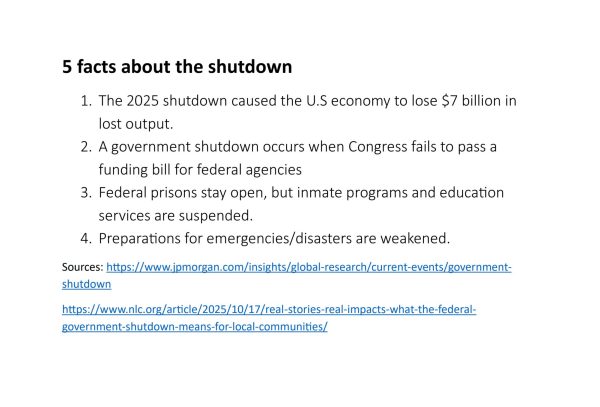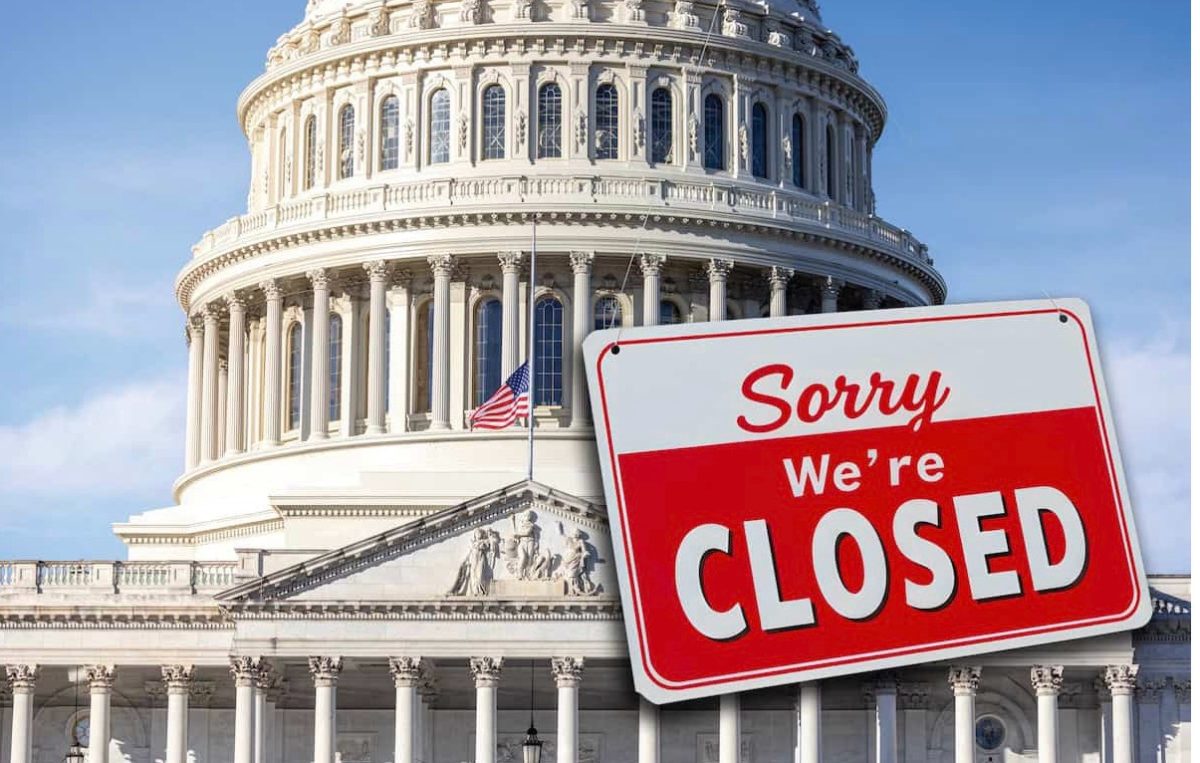
On October 1st, 2025, the United States government announced it would shut down.
The shutdown lasted longer than expected, ending on November 12. According to
the article “Longest Government Shutdown,” posted on the website for National Public
Radio, “It was the longest shutdown in U.S. history at 43 days.” The shutdown was extended
because Republicans and Democrats could not settle on a compromise about expanding
the Affordable Care Act.
Individuals also voiced their ideas on how the government could have ended the
shutdown. Ms. Diaz, a digital graphics teacher, explained that leaders should have been
more cautious of the consequences before shutting down since the government is
supposed to serve the citizens.
A female junior student said, “Instead of arguing on healthcare funding for more
than a month, they should have made an agreement during the first week and not pushed it back. Students and families also deserve to be acknowledged on issues like this.”
Many people learned about the shutdown through loved ones. Junior Andrew
Harrison said, “I first heard about the shutdown by watching the news with my family. I also
saw on social media why it was shutting down.” Ms. Diaz added, “My mother-in-law who
works for the government texted me how she was scared that she will be affected by the
shutdown.”
Families and communities were affected by the shutdown. Sophomore Katlyn
Zaldivar expressed concern about whether this would affect her aunt, who benefits from
food assistance programs like many families across the nation.
In an article titled “Government shutdown impact: By the numbers” posted on ABC
News website states, “42 million is the approximate number of Supplemental Nutrition
Assistance Program (SNAP) recipients who lost their benefits during the shutdown.”
After the shutdown, some people shared their feelings. Mr. Brown, a construction
teacher at Miami High, said that he felt empathy for the families who were affected and
hoped such events would not repeat. Sophomore Stephanie Gomez added, “Having
families in this country worry about food because of a disagreement is very inconsiderate.”
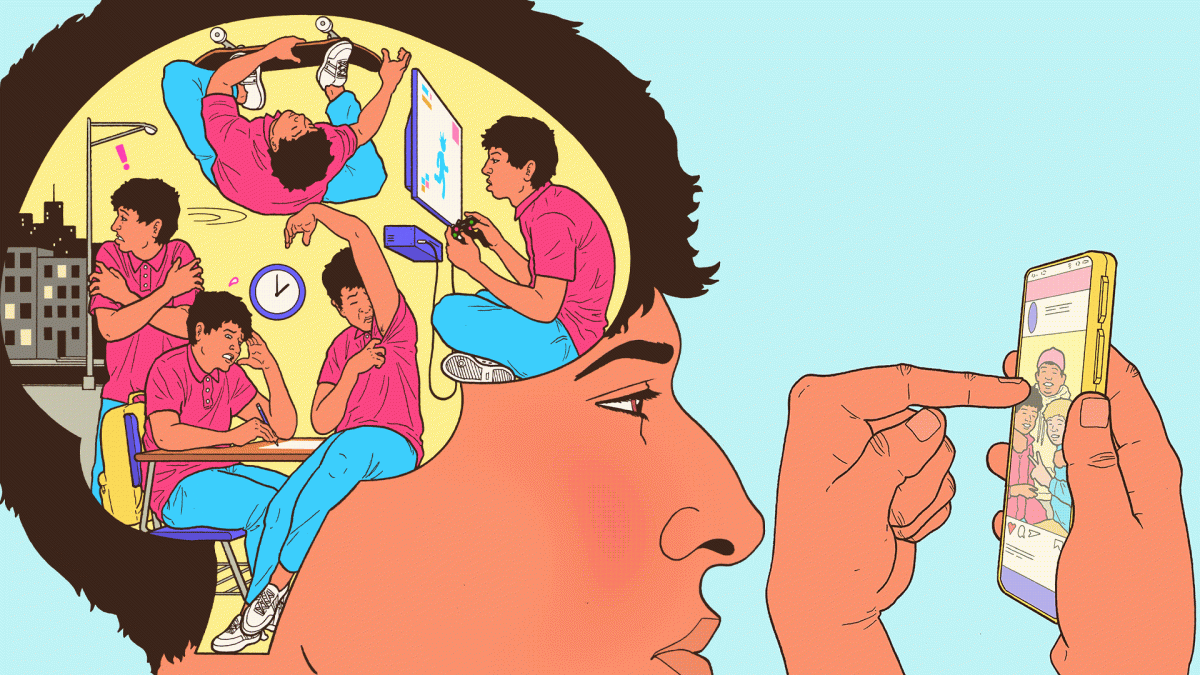
Young people can find ways to make their voices heard on political issues by
sending a letter or emailing the government. Mr. Brown adds, “Students should start using
social media as a way to communicate their thoughts by reposting or making their own
posts.”
According to an article titled “Circle survey shows media creation encourages
confidence and civic engagement in teens” posted on the website for the school
newspaper at Tufts university, “Teens who create media that deals with social or political
issues not only have more confidence in using their political voices but are more physically
engaged.”
In addition, students can start learning more about this topic using trusted sources.
Sophomore Dana Flores said she only searched for articles that are unbiased and use
factual data. Unbiased articles are helpful for understanding more about the government
shutdown because they provide actual facts without bias interfering with the truth.