Students at Miami High say the healthcare system in the United States needs improvement, especially when it comes to cost, access, and education. Many students believe families in their community struggle to get medical care because it is too expensive, too far away, or too confusing to understand.
Across the United States, millions of people face these problems. According to the Centers for Disease Control and Prevention (CDC), about 8.2% of Americans, or roughly 27 million people, did not have health insurance in 2024. Experts also report that nearly half of uninsured adults have trouble paying for healthcare costs, which can lead to medical debt. Studies have also shown that medical bills are one of the leading causes of financial problems for many families.
Healthcare costs continue to rise each year. According to the U.S. Bureau of Labor Statistics, in 2024, the average annual cost of individual health insurance in the United States was $8,951, while the average cost for a family policy was $25,572. Because of these costs, some people avoid going to the doctor unless it is an emergency, which can cause small health issues to become more serious over time.
Parents pay for medical bills using insurance, savings accounts (HSA/FSA), or by negotiating directly with providers for lower rates or payment plans. Other options include government programs like Medicaid/CHIP, medical credit cards, personal loans, or, for separated parents, using court-ordered child support agreements.
Aaron Curtis, a junior at Miami High, said cost is one of the biggest barriers to healthcare. “A lot of people don’t go to the doctor because they can’t afford it,” he said. “Even basic checkups and medicine can be too expensive for families.” Curtis said his family pays for healthcare through insurance provided by his parents’ jobs, but he admits he does not know all the details about how it works.
Jairo Paiz, also a junior, said many students are not fully aware of how their families pay for medical bills. “I think my family has insurance too, but nobody really explains how it works,” he said. Paiz believes schools should teach students more about healthcare so they can better understand how insurance and medical costs affect their families.
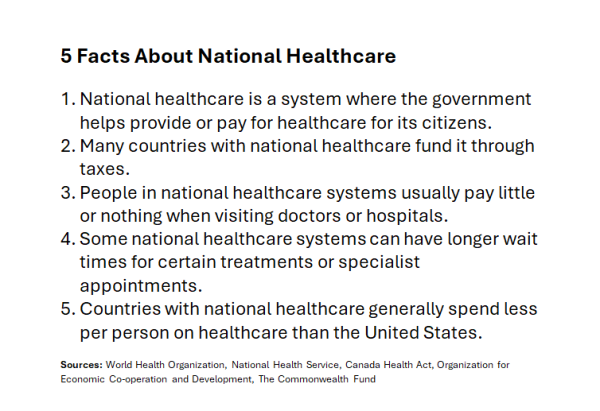
Joshua Villarreal, another junior, said learning about healthcare systems in other countries has helped him understand how different systems work. “In some countries like Canada or the United Kingdom, healthcare is funded mostly through taxes,” he explained. “That means people don’t have to pay as much when they go to the doctor.”
Students also shared their personal experiences with visiting doctors. Curtis said his last doctor’s visit was mostly positive. “The doctor checked everything and explained what I needed to do to stay healthy,” he said.
Paiz agreed that the care itself is usually helpful but said the process can sometimes take a long time. “It was good overall, but sometimes the waiting time can be long,” he said.
Healthcare experts say improving access to insurance, lowering prescription drug prices, and expanding community clinics could help address some of these issues. Preventive care and health education are also seen as important ways to reduce long-term healthcare costs.
As healthcare continues to be debated across the country, Miami High students hope their voices will be heard. “Everyone deserves to be healthy,” Curtis said. “It shouldn’t depend on how much money you have.”